

Program
The Master of the Scholarship of Teaching and Learning (MSoTL) at the University of Saskatchewan is a hybrid graduate program for educators who want to study and strengthen teaching and learning in meaningful ways. Grounded in inquiry, reflection, and impact, the program prepares participants to design and conduct rigorous Scholarship of Teaching and Learning (SoTL) research that is rooted in their own contexts.
With flexible elective options, students can deepen their methodological expertise or focus on leadership and change, shaping the degree to align with their professional goals.
Why choose USask for Scholarship of Teaching and Learning?
- Learn within the Graham Centre for the Scholarship of Teaching and Learning, a national hub for SoTL research and professional learning.
- Benefit from interdisciplinary mentorship and collaborative networks that support authentic, practice‑embedded inquiry.
- Join a university committed to enhancing teaching quality through research‑driven approaches and educator development.
Quick facts
-
Expected Length Thesis-based Course-based M.SoTL. 2 years G.Cert. 1 year - M.SoTL. Degree requirements
- G.Cert. Certificate requirements
- Class delivery hybrid (in-person and online)
- Supervisor approval not required to apply
- Deadlines and admission details below
Leaders in transforming teaching through inquiry
Advance your ability to study your own practice, illuminate what supports meaningful learning, and contribute to a growing community committed to improving education. Here, you will shape research that inspires pedagogical innovation and elevates teaching across disciplines.
Master of the Scholarship of Teaching and Learning

The Master of the Scholarship of Teaching and Learning hybrid program will provide you with a level of specialization in conducting SoTL research, while providing opportunities through elective courses to shape the program to your professional goals. If your professional goal is to conduct a particular kind of research, you can take methodology courses to build expertise. If you want to provide leadership and facilitate others' growth, you can take electives that emphasize leadership and change agency.
The research-intensive focus of this Master’s program develops your capacity to lead and contribute to the Scholarship of Teaching and Learning by enabling you to:
-
Critically examine how disciplinary contexts shape teaching, learning, and knowledge production, and articulate their implications for SoTL inquiry.
-
Design and implement contextually grounded SoTL studies that thoughtfully align research questions, methodologies, and methods with disciplinary and institutional settings.
-
Generate and mobilize SoTL knowledge through diverse dissemination pathways, including peer-reviewed venues, institutional forums, and public-facing scholarship.
-
Analyze how epistemological, methodological, and contextual differences across disciplines influence the conduct and interpretation of SoTL research.
-
Cultivate leadership in SoTL by facilitating collaborative inquiry into teaching and learning and advancing a culture of scholarly practice.
-
Mentor and support educators in developing their own SoTL questions, fostering reflective, evidence-informed, and context-responsive teaching practices.
International students, For questions related to immigration matters, please contact Megan Fillatre or the International Student and Study Abroad Centre (ISSAC)
Graduate Certificate in the Scholarship of Teaching and Learning
In the online Graduate Certificate in the Scholarship of Teaching and Learning, you will develop the capacity to engage in systematic, contextually grounded inquiry into teaching and learning, including:
-
Examining how disciplinary contexts shape teaching practices, student learning, and knowledge construction.
-
Designing and applying appropriate SoTL methodologies within your own educational setting, thoughtfully adapting approaches to disciplinary and contextual realities.
-
Conducting and disseminating SoTL projects—scholarly and/or creative—that contribute to local, national, and broader teaching and learning conversations.
Cross Departmental Ph.D. in Education – SoTL Focus
Students can pursue a Ph.D. in Education with a focus on SoTL topics and research through the Cross-Departmental Ph.D. in the College of Education. This dissertation‑based degree prepares graduates for academic roles and positions that support teaching and learning in higher education.
Research supervisors
It is not necessary to contact faculty before you apply to this program.
| Name | Research areas |
|---|---|
| Social studies education; history education; civic education; anticolonial education; environmental and outdoor education; public pedagogy; poststructuralism; posthumanism | |
| Visual Literacy and Visual Diagnostic Reasoning; Cytology and Hematology Teaching | |
| Early Career Scholarship of Teaching and Learning (SoTL); Mid-Career Faculty; SoTL Leadership; SoTL programming; Academic Integrity | |
| K-12 Teaching; Teacher Education; Robotics in Pre- and In-Service Teacher Education; Digital Technology as Learning Tool in K-12; Playful Learning in K-12 and Post-secondary Education; and Teaching and that supports 21st Century Skills and Global Competencies | |
| Biomechanics||Medical Imaging||Computational Mechanics (Finite Element and Modelling) | |
| Learning theory; technology-enhanced learning; instructional design; mobile learning; sociomaterialism; postdigital; and educational technology & social justice | |
| AR; VR; XR; AI education; digital literacy; game-based learning; online learning; virtual reality; instructional design; digital well-being; sustainability | |
| Indigenous education; educational leadership; governance and organizational development; school improvement; community development | |
| Literacies; pedagogies; early elementary education; teacher professional learning | |
| Ethics and Responsibility; Theory & Practice in Science Education; Intersections of 'place; nature; and education'; Pre-service Teacher Education. | |
| Post-secondary education; leadership; assessment and evaluation; organizational theory; scholarship of teaching and learning | |
| Scholarship of Teaching and Learning (SoTL); SoTL Leadership; SoTL in Canada; Threshold Concepts; Pre-service Teacher Education | |
| Technology skill development; media literacy; program evaluation; social agency in teaching /learning; experiential learning; design studio learning | |
| Scholarship of Teaching and Learning (SoTL); Academic Integrity; Demential Engagement Strategies; Learner Engagement: experiential learning; use of humour; cinemeduction | |
| Change in higher education teaching practices, departmental level change, social practice theory, EDI in higher education teaching practices, informal and professional learning |
Tuition and funding
Funding
Through the Office of the Associate Dean (Research, Graduate Support, and International Initiatives), the College of Education provides graduate students scholarship and bursary funding. For more information visit our College of Education graduate scholarship opportunities.
Graduate students at USask can receive funding from a variety of sources to support their graduate education.
Tuition and fees
Thesis or project-based master's program
Students in thesis and project-based master's programs are assessed tuition three times a year for as long as they are enrolled in their program.
| Term | Canadian students | International students |
|---|---|---|
| September 1 - December 31, 2026 | ||
| January 1 - April 30, 2027 | ||
| May 1 - August 31, 2027 | ||
| Total per academic year |
Student fees
In addition to tuition above, students also pay fees for programs like health and dental insurance, a bus pass, and other campus services. The amount you need to pay depends on if you are taking classes full time or part time, and if you are on campus or not. The table below assumes you are on campus full-time.
| Fall 2026 | Winter 2027 | Spring 2027 | Summer 2027 | |
|---|---|---|---|---|
| Student fees | $617.36 CAD | $854.96 CAD | $46.75 CAD | $46.75 CAD |
Tuition is typically billed and due in instalments, four times per year. Tuition information is accurate for the current academic year and does not include student fees. For detailed tuition and fees information, visit the official tuition website.
Course-based master's, certificate or postgraduate diploma program
Students in course-based certificate, master's, and postgraduate diploma programs are assessed tuition per credit unit based on the number of classes they take. A typical 3-credit-unit class costs three times the per-credit-unit rate. Students not enrolled in classes must register in Maintenance of Status and are assessed tuition at the 3-credit-unit rate.
| Canadian students | International students | |
|---|---|---|
| Maintenance of Status course | ||
| Cost per graduate credit unit | ||
| Cost per 3 credit unit graduate class |
Graduate students in course-based programs registered in any undergraduate classes will be assessed tuition for these classes at the undergraduate rate. International graduate students in these programs registered in undergraduate courses, whether or not the classes are part of their program of study, will also be assessed the undergraduate international tuition.
Student fees
In addition to tuition above, students also pay fees for programs like health and dental insurance, a bus pass, and other campus services. The amount you need to pay depends on if you are taking classes full time or part time, and if you are on campus or not. The table below assumes you are on campus full-time.
| Fall 2026 | Winter 2027 | Spring 2027 | Summer 2027 | |
|---|---|---|---|---|
| Student fees | $617.36 CAD | $854.96 CAD | $46.75 CAD | $46.75 CAD |
Tuition is typically billed and due in instalments, four times per year. Tuition information is accurate for the current academic year and does not include student fees. For detailed tuition and fees information, visit the official tuition website.
Admission requirements
- A four-year bachelor's degree or equivalent from a recognized college or university
- A cumulative weighted average of at least a 70% (USask grade system equivalent) in the last two years of study (i.e., 60 credit units)
- Teaching experience or equivalent experience in a non-formal or training environment
- Language Proficiency Requirements: Proof of English proficiency may be required for international applicants and for applicants whose first language is not English
- A four-year bachelor's degree or equivalent from a recognized college or university
- A cumulative weighted average of at least a 70% (USask grade system equivalent) in the last two years of study (i.e., 60 credit units)
- Teaching experience or equivalent experience in a non-formal or training environment
- Language Proficiency Requirements: Proof of English proficiency may be required for international applicants and for applicants whose first language is not English
Application process and deadlines
Deadlines and important dates
| Program | Start Term | Application Deadline | International Deadline |
| M.SoTL. | Fall Term September |
April 1 | February 1 |
| G.Cert. | Fall Term September 2026 |
April 1, 2026 | February 1, 2026 |
| G.Cert. | Winter Term January 2027 |
November 15, 2026 | * |
| G.Cert. | Fall Term September 2027 |
July 15, 2026 | July 15, 2026 |
*This G.Cert. program is not available to international students in the winter term.
Graduate Certificate Program: Please contact sotl@usask.ca to determine if you are eligible to start the program January 1.
Submit an online application
International Students - Master’s and doctoral students applying for a study permit do not need a Provincial Attestation Letter (PAL). Certificate and Postgraduate Diploma students, as well as Visiting Research students studying over six months, still need a PAL. Review federal international study permit policies before you apply.
Before beginning your online application, be sure that you have carefully reviewed all program information and admission requirements on this page.
During the application, you'll be asked for:
- Personal information such as your name, address, etc.
- Contact information of your three referees
- For your letters of recommendation, one of your referees must be an academic contact, and the other two may be academic or professional
- Your complete academic history from all previous post-secondary institutions
The application takes about 30 minutes to complete. You may save your application and return to it later.
At the end of the application, you will need to pay a non-refundable application fee: $125 for domestic students and $145 for international students. Your application will not be processed until payment is received.
Submit required documents
Once you've submitted your online application, you will have access to upload your required documents, and provide the contact information for your references. To do this, go to the "Supplemental Items & Documents" tab in your application.
Preliminary Statement of Marks
- Once you have submitted your application for admission and paid the application fee, you will be required to upload unofficial PDF copies of your academic transcript(s) from each post-secondary institution attended. This requirement will appear as Preliminary Statement of Marks or Additional Prelim. Statement under admission requirements on your Application Summary when you check your application status.
- The uploaded transcript can be an unofficial copy of the transcript issued by the university or college and must include a grading key/legend.
- All pages of a transcript must be uploaded as a single PDF document.
- Uploaded transcripts will be considered unofficial or preliminary. Official copies of your transcripts will be required only for applicants offered admission. This requirement will appear as Post-secondary Transcript under admission requirements on your Application Summary when you check your application status.
- Transcripts in languages other than English must be accompanied by a certified translation.
For students who are required to provide proof of English proficiency:
- Completing a relevant test with the appropriate score is required before the application deadline.
- Tests are valid for 24 months after the testing date and must be valid at the beginning of the student's first term of registration in the graduate program.
- Applicants will be required to upload a PDF copy of any required language test score. Uploaded test scores will be considered unofficial or preliminary.
You may be required to submit the following documents:
- Statement of Intent (one or two pages) that includes:
- Why are you interested in pursuing master's-level studies in the School of Teaching and Learning?
- Biography/professional background
- Future career aspirations
- Curriculum vitae or resume
Contact
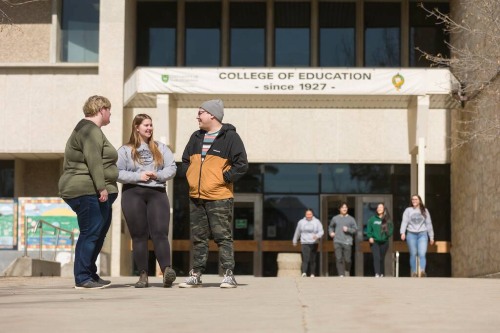
Department of Education
28 Campus Drive
University of Saskatchewan
Saskatoon, SK S7N 0X1
Director
Dr. Melanie Hamilton
Email: melanie.hamilton@usask.ca
Program Coordinator
Alison Kraft
Email: sotl@usask.ca
- Scholarship of Teaching and Learning
Learn more about the academic unit offering this program - Program and Course Catalogue
To view official admission and program requirements