

Program
At the University of Saskatchewan, graduate study in Music spans performance, conducting, music education, theory, and musicology. Each program culminates in a recital, project, or thesis that reflects disciplinary rigour and individual direction.
Why study Music at USask?
- Access professional and financial support, including graduate scholarships and teaching assistantships.
- The M.Mus. in Performance program involves individualized mentorship through intensive one‑on‑one study with experienced scholars and performing artists.
- In the musicology and theory programs, individual study paths may be possible, with coursework tailored by the graduate committee.
- Opportunities to participate in the Fine Arts Research Lecture Series in Music.
Quick facts
-
Expected length Thesis-based Project-based Course-based M.Mus. 2 years M.A. 2 years - Degree requirements
- Class delivery in-person
- Supervisor approval not required to apply
- Deadlines and admission details below
Illuminators in music
Resonate beyond the studio and the stage at USask by contributing to an ongoing exchange of ideas through the pursuit of music as inquiry, expression, and vocation within a graduate community that values depth, discipline, and artistic purpose.
Masters programs in Music
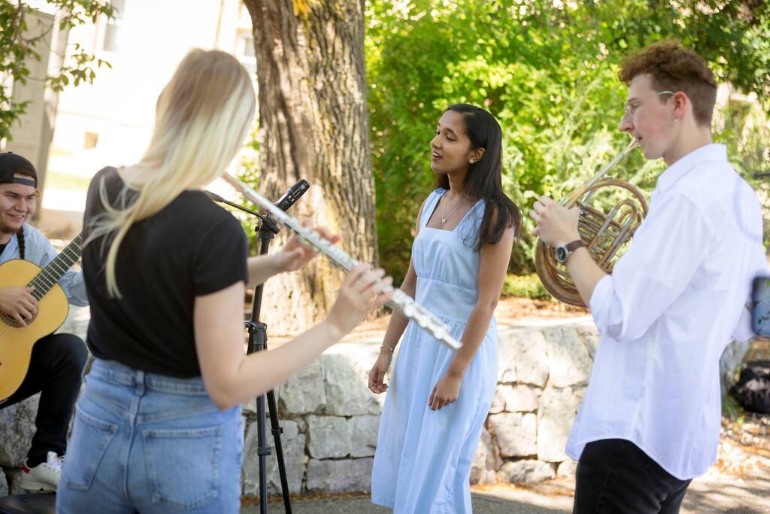
Graduate degrees in Music at the University of Saskatchewan are an opportunity for students to do intensive one-on-one study with experienced scholars and performing artists with particular specialties in piano, collaborative piano, voice, strings, brass, woodwinds, conducting (choral and wind), music education, theory, and musicology. Our musicology and theory programs focus primarily on 18th, 19th, and 20th century classical repertoire, though individual study paths may be possible in consultation with our graduate committee.
Each program culminates in a project, recital, or thesis, depending on the discipline and degree. Courses are carefully tailored to each student by the graduate committee to complement studies in the major areas.
The USask School for the Arts, in the Music area, offers programs in music theory, conducting, and performance leading to a Master of Music (M.Mus.) and in musicology leading to a Master of Arts (M.A.) degree.
Master of Music in Performance
Project-based
The Master of Music in Performance is available for performers in piano, collaborative piano, voice, strings, brass, or woodwinds, as well as to students pursuing a conducting concentration. The conducting M.Mus. in Performance may be completed with an emphasis in choral conducting or wind band conducting. This program requires 24 credit units and is project‑based, culminating in a final recital in the area of study.
Master of Music in Composition or Music Theory
Thesis-based
The M.Mus. program in music theory require 15 credit units plus a thesis. The normal time for completion is two years, including a one-year residency.
Master of Arts in Musicology
Thesis-based
The M.A. program in musicology require 15 credit units plus a thesis. The normal time for completion is two years, including a one-year residency.
A meaningful graduate experience is enhanced by participating in professional activities. Toward that end, the University of Saskatchewan offers the annual Fine Arts Research Lecture Series in Music, providing a forum for the exchange of scholarly ideas through the presentation of scholarly research in formal papers and lecture recitals prepared by both members of the School for the Arts - Music and guests from the national and international scholarly community.
Interested in music education? Explore the Master of Music Education (M.Mus.) program.
Research supervisors
We recommend that you review the faculty list below to determine if a faculty member is doing research in an area that interests you before beginning a formal application.
| Name | Research areas |
|---|---|
| Decolonization, Indigenization, and Reconciliation; Music Education; Curriculum, Pedagogical Practices, and Assessment | |
| Musicology; 18th-20th century art music; Women composers and performers; Performance and improvisation; Music aesthetics; German musical culture; Literature and music; Early hip hop | |
| Music Education; Choral Conducting; Engagement and Agency in Music Education Programs; Intergenerational Singing; Informal Music Learning; Newcomer Youth Engagement Music Programs; | |
| Violin; Viola; Chamber music; Contemporary music; Strings | |
| Jazz; Music; Improvisation; Creativity; Composition; Classical; Baroque; Interdiciplinary | |
| Wind orchestra; History of the Bands of the RCMP; Wind conducting; Canadian Wind Band History | |
| 20th & 21st century orchestral music; Canadian Composers; Chamber Music; Composition Pedagogy; Contemporary Composers; East Asian Traditional Music; Music Composition; Vocal and Operatic composition |
Tuition and funding
Funding
Generous graduate scholarships are available and are awarded on the basis of excellence and potential in the area of specialization. Teaching assistantships may be applied for and are awarded on the basis of proven competency in teaching. Visit the School of the Arts - Music for more information.
Graduate students at USask can receive funding from a variety of sources to support their graduate education.
Tuition and fees
Thesis or project-based master's program
Students in thesis and project-based master's programs are assessed tuition three times a year for as long as they are enrolled in their program.
| Term | Canadian students | International students |
|---|---|---|
| September 1 - December 31, 2026 | ||
| January 1 - April 30, 2027 | ||
| May 1 - August 31, 2027 | ||
| Total per academic year |
Student fees
In addition to tuition above, students also pay fees for programs like health and dental insurance, a bus pass, and other campus services. The amount you need to pay depends on if you are taking classes full time or part time, and if you are on campus or not. The table below assumes you are on campus full-time.
| Fall 2026 | Winter 2027 | Spring 2027 | Summer 2027 | |
|---|---|---|---|---|
| Student fees | $617.36 CAD | $854.96 CAD | $46.75 CAD | $46.75 CAD |
Tuition is typically billed and due in instalments, four times per year. Tuition information is accurate for the current academic year and does not include student fees. For detailed tuition and fees information, visit the official tuition website.
Thesis or project-based master's program
Students in thesis and project-based master's programs are assessed tuition three times a year for as long as they are enrolled in their program.
| Term | Canadian students | International students |
|---|---|---|
| September 1 - December 31, 2026 | ||
| January 1 - April 30, 2027 | ||
| May 1 - August 31, 2027 | ||
| Total per academic year |
Student fees
In addition to tuition above, students also pay fees for programs like health and dental insurance, a bus pass, and other campus services. The amount you need to pay depends on if you are taking classes full time or part time, and if you are on campus or not. The table below assumes you are on campus full-time.
| Fall 2026 | Winter 2027 | Spring 2027 | Summer 2027 | |
|---|---|---|---|---|
| Student fees | $617.36 CAD | $854.96 CAD | $46.75 CAD | $46.75 CAD |
Tuition is typically billed and due in instalments, four times per year. Tuition information is accurate for the current academic year and does not include student fees. For detailed tuition and fees information, visit the official tuition website.
Admission requirements
- Language Proficiency Requirements: Proof of English proficiency may be required for international applicants and for applicants whose first language is not English
- A completed online application, the application fee and all supporting application documents
- A cumulative weighted average of at least a 70% (USask grade system equivalent) in the last two years of study (i.e. 60 credit units)
- A four-year honours degree, or equivalent, from a recognized college or university in an academic discipline relevant to the proposed field of study
- Language Proficiency Requirements: Proof of English proficiency may be required for international applicants and for applicants whose first language is not English
- A completed on-line application, the application fee and all supporting application documents
- A cumulative weighted average of at least a 70% (USask grade system equivalent) in the last two years of study (i.e. 60 credit units)
- A four-year honours degree, or equivalent, from a recognized college or university in an academic discipline relevant to the proposed field of study
Application process and deadlines
Deadlines and important dates
| Start Term | Application Deadline |
|
September |
February 1 |
The M.Mus. (Performance) – project-based program application deadline is October 1 for a January start.
Submit an online application
International students - Master's and doctoral students applying for a study permit do not need a Provincial Attestation Letter (PAL). Certificate and Postgraduate Diploma students, as well as Visiting Research students studying over six months, still need a PAL. Review federal international study permit policies before you apply.
Before beginning your online application, be sure that you have carefully reviewed all program information and admission requirements on this page.
During the application, you'll be asked for:
- Personal information such as your name, address, etc.
- Contact information of your three referees
- For your letters of recommendation, two of your referees must be academic contacts, and the third may be academic or professional
- Your complete academic history from all previous post-secondary institutions
The application takes about 30 minutes to complete. You may save your application and return to it later.
At the end of the application, you will need to pay a non-refundable application fee: $125 for domestic students and $145 for international students. Your application will not be processed until payment is received.
Submit required documents
Once you've submitted your online application, you will have access to upload your required documents, and provide the contact information for your references. To do this, go to the "Supplemental Items & Documents" tab in your application.
Preliminary Statement of Marks
- Once you have submitted your application for admission and paid the application fee, you will be required to upload unofficial PDF copies of your academic transcript(s) from each post-secondary institution attended. This requirement will appear as Preliminary Statement of Marks or Additional Prelim. Statement under admission requirements on your Application Summary when you check your application status.
- The uploaded transcript can be an unofficial copy of the transcript issued by the university or college and must include a grading key/legend.
- All pages of a transcript must be uploaded as a single PDF document.
- Uploaded transcripts will be considered unofficial or preliminary. Official copies of your transcripts will be required only for applicants offered admission. This requirement will appear as Post-secondary Transcript under admission requirements on your Application Summary when you check your application status.
- Transcripts in languages other than English must be accompanied by a certified translation.
For students who are required to provide proof of English proficiency:
- Completing a relevant test with the appropriate score is required before the application deadline.
- Tests are valid for 24 months after the testing date and must be valid at the beginning of the student's first term of registration in the graduate program.
- Applicants will be required to upload a PDF copy of any required language test score. Uploaded test scores will be considered unofficial or preliminary.
For all M.Mus. and M.A. applications also include:
- 1-2 page statement of intent which describes your prior academic background, readiness to undertake the desired program, and the purpose/rationale for wanting to enroll in the program.
- A Curriculum Vitae
- Arrange for three referees to upload letters of reference
For M.Mus. in Performance applications also include:
- A comprehensive list of studied and performed works.
- An audition
- While in-person auditions are preferred, you may submit unedited video recordings of performances or unlisted YouTube links made within the last 12 months (at least 30 minutes in length). Visit the School of the Arts - Music for additional audition information.
Contact
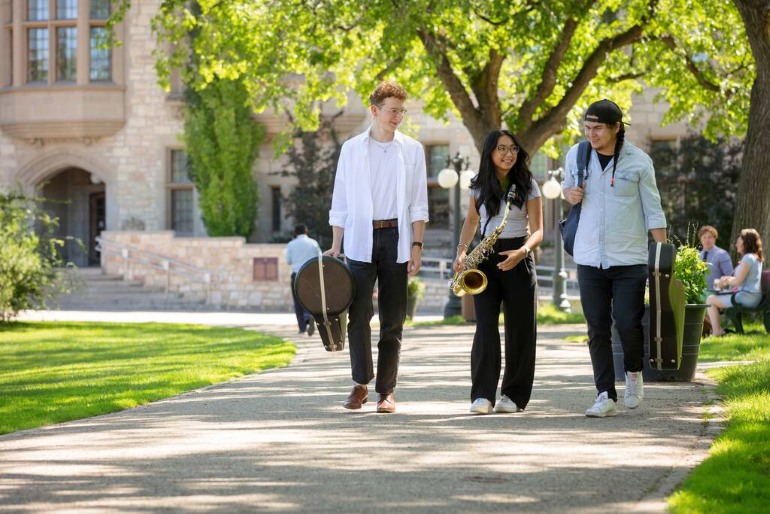
For application inquiries, please contact Application Admin Support.
Graduate Admissions
School for the Arts - Music
9 Campus Drive - Arts Room 518
University of Saskatchewan
Saskatoon, SK S7N 0X1
Graduate Chair
Veronique Mathieu
Email: veronique.mathieu@usask.ca
Application Admin Support
Anna McKenzie
Email: asg.gradapplications@usask.ca
Program Admin Support
Nadine Penner
Email: asg.graduateprograms@usask.ca
- School for the Arts - Music
Learn more about the academic unit offering this program - Program and Course Catalogue
To view official admission and program requirements