

Program
Focused on research grounded in Indigenous priorities and knowledge, the Indigenous Studies graduate programs at the University of Saskatchewan support advanced inquiry into Indigenous societies. Students situate Saskatchewan‑based Indigenous experiences within broader Canadian and global contexts of indigeneity while contributing to expanding approaches to Indigenous Knowledge and scholarship.
Why choose USask for Indigenous Studies?
- Learn from faculty engaged in innovative, community‑based Indigenous research at local to international levels.
- Strengthen your research practice through work grounded in the priorities and knowledge of Saskatchewan’s Indigenous communities.
- Study within a university where Indigenous Peoples is a recognized signature research area.
Quick facts
-
Expected length Thesis-based Course-based M.A. 2 years Ph.D. 4 years - Degree requirements
- Class delivery in-person
- Deadlines and admission details below
Protectors in sustaining Indigenous knowledge and society
Join a graduate program where your research contributes to the continuity and strength of Indigenous societies and knowledge systems. Your studies will be grounded in Indigenous perspectives and relationships, supporting innovative and responsible approaches to Indigenous Knowledge.
Indigenous Studies masters and Ph.D. research areas
From its multi-disciplinary foundation, Indigenous Studies is progressively acquiring an independent and unique basis for its teaching and research. The Department of Indigenous Studies seeks to provide an intellectual milieu where teaching and research are well grounded in the priorities and knowledge of Saskatchewan’s Indigenous communities, all the while placing them within the larger fabric of the Canadian Indigenous experience and the emergent global, social phenomenon of indigeneity.
Researchers and students in Indigenous Studies explore and seek to understand the fundamental nature of Indigenous society. As a centre of academic inquiry based on sound pedagogical and research principles, the Department of Indigenous Studies strives to develop more expansive and innovative views on Indigenous Knowledge.
Master of Arts (M.A.)
All students in this program will complete 18 credit units of course work (typically six classes) and a thesis. There is no project option in this program.
Doctor of Philosophy (Ph.D.)
All students in this program will complete 12 credit units of course work (typically four classes) and a thesis. There is no project option in this program.
Research supervisors
Please read through list below to learn about our faculty research interests.
| Name | Research areas |
|---|---|
| International Indigenous Studies (Governance, Education, Law, Scientific Accomplishments); Pre-colonization, colonization, decolonization; Mayan Studies (Religion and Spirituality, Ways of Knowing); Genocide; Social Justice and Law | |
| Aboriginal; Indigenous; Saskatchewan; community; community engagement; governance; health; public policy | |
| Community engagement; Criminology; Decolonial theory; Digital storytelling; Indigenous health; Indigenous methodologies; Indigenous theory; Metis Indigeneity; Photovoice; Relational accountability; Street gangs; Street lifestyles; Survivance; Visual research methodologies | |
| Indigenous kinship and citizenship orders; Indigenous legal and political orders; Treaty constitutionalism; Indigenist Research Methodologies | |
| Indigenous Literatures; Metis Family Narratives; Indigenous Futurisms; Zines & Ephemeral Print; Cultural Studies; Digital Humanities; ; | |
| Indigenous Child Welfare History; Métis History; Métis Political Activism | |
| Community-Based; anti-colonial; education; indigenous; knowledge; oral history; women |
Tuition and funding
Funding
All successful applicants for graduate studies in the department are considered for support or scholarship on the basis of merit. No separate application is required.
Graduate students at USask can receive funding from a variety of sources to support their graduate education.
Tuition and fees
Thesis or project-based master's program
Students in thesis and project-based master's programs are assessed tuition three times a year for as long as they are enrolled in their program.
| Term | Canadian students | International students |
|---|---|---|
| September 1 - December 31, 2026 | ||
| January 1 - April 30, 2027 | ||
| May 1 - August 31, 2027 | ||
| Total per academic year |
Student fees
In addition to tuition above, students also pay fees for programs like health and dental insurance, a bus pass, and other campus services. The amount you need to pay depends on if you are taking classes full time or part time, and if you are on campus or not. The table below assumes you are on campus full-time.
| Fall 2026 | Winter 2027 | Spring 2027 | Summer 2027 | |
|---|---|---|---|---|
| Student fees | $617.36 CAD | $854.96 CAD | $46.75 CAD | $46.75 CAD |
Tuition is typically billed and due in instalments, four times per year. Tuition information is accurate for the current academic year and does not include student fees. For detailed tuition and fees information, visit the official tuition website.
Doctoral program
Doctoral students are assessed tuition three times a year for as long as they are enrolled in their program. Both international and domestic PhD students pay the same rate.
| Term | |
|---|---|
| September 1 - December 31, 2026 | $1,879.00 CAD |
| January 1 - April 30, 2027 | $1,879.00 CAD |
| May 1 - August 31, 2027 | $1,879.00 CAD |
| Total per academic year | $5,637.00 CAD |
Student fees
In addition to tuition above, students also pay fees for programs like health and dental insurance, a bus pass, and other campus services. The amount you need to pay depends on if you are taking classes full time or part time, and if you are on campus or not. The table below assumes you are on campus full-time.
| Fall 2026 | Winter 2027 | Spring 2027 | Summer 2027 | |
|---|---|---|---|---|
| Student fees | $617.36 CAD | $854.96 CAD | $46.75 CAD | $46.75 CAD |
Tuition is typically billed and due in instalments, four times per year. Tuition information is accurate for the current academic year and does not include student fees. For detailed tuition and fees information, visit the official tuition website.
Admission requirements
- Language Proficiency Requirements: Proof of English proficiency may be required for international applicants and for applicants whose first language is not English
- A cumulative weighted average of at least a 70% (USask grade system equivalent) in the last two years of study (i.e. 60 credit units)
- A four-year honours degree, or equivalent, from a recognized college or university in an academic discipline relevant to the proposed field of study
- A cumulative weighted average of at least 70% or equivalent (USask grade system equivalent) in last two years of study.
- Language Proficiency Requirements: Proof of English proficiency may be required for international applicants and for applicants whose first language is not English
- Master of Arts (M.A.) or equivalent in related field from a recognized college or university
Application process and deadlines
Deadlines and important dates
| Start Term | Application Deadline |
|
September |
January 15 |
Submit an online application
International students - Master's and doctoral students applying for a study permit do not need a Provincial Attestation Letter (PAL). Certificate and Postgraduate Diploma students, as well as Visiting Research students studying over six months, still need a PAL. Review federal international study permit policies before you apply.
Before beginning your online application, be sure that you have carefully reviewed all program information and admission requirements on this page.
During the application, you'll be asked for:
- Personal information such as your name, address, etc.
- Contact information of your three referees
- For your letters of recommendation, two of your referees must be academic contacts, and the third may be academic or professional
- Your complete academic history from all previous post-secondary institutions
The application takes about 30 minutes to complete. You may save your application and return to it later.
At the end of the application, you will need to pay a non-refundable application fee: $125 for domestic students and $145 for international students. Your application will not be processed until payment is received.
Submit required documents
Once you've submitted your online application, you will have access to upload your required documents, and provide the contact information for your references. To do this, go to the "Supplemental Items & Documents" tab in your application.
Preliminary Statement of Marks
- Once you have submitted your application for admission and paid the application fee, you will be required to upload unofficial PDF copies of your academic transcript(s) from each post-secondary institution attended. This requirement will appear as Preliminary Statement of Marks or Additional Prelim. Statement under admission requirements on your Application Summary when you check your application status.
- The uploaded transcript can be an unofficial copy of the transcript issued by the university or college and must include a grading key/legend.
- All pages of a transcript must be uploaded as a single PDF document.
- Uploaded transcripts will be considered unofficial or preliminary. Official copies of your transcripts will be required only for applicants offered admission. This requirement will appear as Post-secondary Transcript under admission requirements on your Application Summary when you check your application status.
- Transcripts in languages other than English must be accompanied by a certified translation.
For students who are required to provide proof of English proficiency:
- Completing a relevant test with the appropriate score is required before the application deadline.
- Tests are valid for 24 months after the testing date and must be valid at the beginning of the student's first term of registration in the graduate program.
- Applicants will be required to upload a PDF copy of any required language test score. Uploaded test scores will be considered unofficial or preliminary.
In addition to the above official documents, please upload the following documents:
- A writing sample
- A statement/letter of intent (two pages) outlining:
- Your proposed area of research
- A summary of your research plan
- The Indigenous Studies faculty member that you would like to supervise your project and the reasons why you want them as a supervisor
- Other potential committee members in the Department of Indigenous Studies or at the University of Saskatchewan
- Graduate courses that you plan to enroll in
- Financial support that you have (or plan to) apply for.
Contact
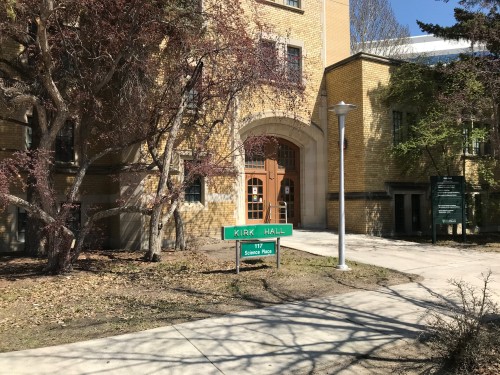
142 Kirk Hall, 117 Science Place
University of Saskatchewan
Saskatoon, SK S7N 5C8
Graduate Chair
Dr. Leonzo Barreno
Email: leb002@mail.usask.ca
Telephone: 306-966-2512
Graduate Administrator
Michelle Jarvin
Email: michelle.jarvin@usask.ca
Telephone: 306-966-6209
- Indigenous Studies
Learn more about the academic unit offering this program - Program and Course Catalogue
To view official admission and program requirements