

Program
Built for research‑driven graduate students, the Geological Sciences program at the University of Saskatchewan supports advanced study across geochemistry, geophysics, paleontology, mineralogy, structural geology, and related fields. Students pursue focused research using specialized laboratories and computing resources while contributing to deeper understanding of Earth’s physical, chemical, and biological systems and their relevance to today’s challenges.
Why study Geological Sciences at USask?
- Access to world‑class laboratories dedicated to isotopes, diffraction, geochemistry, and mineral analysis.
- Strengthen analytical capability through access to the Canadian Light Source, Canada’s only synchrotron.
- Work within a department recognized internationally for geoscience research facilities and training.
Quick facts
-
Expected length Thesis-based Course-based M.Sc. 2 years Ph.D. 4 years - Degree requirements
- Class delivery in-person
- Supervisor approval is required to apply
- Deadlines and admission details below
Groundbreakers in uncovering Earth’s deep history
Explore Earth’s physical, chemical, and biological complexity using some of the most advanced geoscience facilities in Canada. This program places technology, instrumentation, and analytical depth at the centre of your graduate experience.
Geological Sciences M.Sc. and Ph.D. research areas
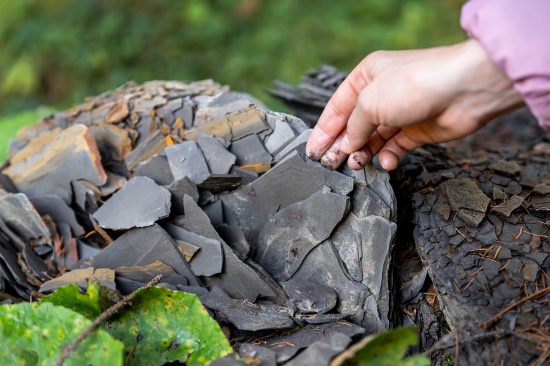
This research-based program allows you to pursue a degree in one of the following fields of geological sciences:
- Geochemistry
- Geophysics
- Paleontology, paleobiology and paleobotany
- Mineralogy, petrology and ore geology
- Structural geology and tectonics
- Sedimentology and stratigraphy
While studying in the Department of Geological Sciences, you will have access to world class facilities to support your research including:
- Saskatchewan Isotope Laboratory
- Electron Microprobe Laboratory
- X-ray Diffraction Laboratory
- Aqueous and Environmental Geochemistry Laboratories
- Electronic Paramagnetic Resonance Laboratory
- Hydrothermal Mineralogy and Geochemistry Laboratory
- Global Geochronology and Lithostratigraphy Database
- Advanced computing facilities
You will also have access to other world class facilities housed at the University of Saskatchewan including:
- Canadian Light Source – Canada’s only synchrotron
- Saskatchewan Structural Sciences Centre
- Advanced (electron) microscopy facilities
Research supervisors
You will need to contact the faculty that are doing research in an area that interests you before beginning a formal application. You cannot be admitted to this program without a faculty supervisor in place.
| Name | Research areas |
|---|---|
| Isotope geology; Mineral deposits; Precambrian Geology; Trans-Hudson Orogen; base metals; critical minerals; lithogeochemistry; petrology; precious metals; rare earth elements; uranium | |
| Ediacaran; Ichnology; Neogene; Paleobiology; Sedimentology; paleontology; stratigraphy | |
| Applied Geophysics; Compaction; Geophysics; Mantle; Numerical modelling; Porous; Tektite | |
| Southern Africa; exploratory data analysis; geochemical; geotectonic; hydrochemistry; isotope | |
| Arsenic; mercury; metals; spectroscopy; toxicology | |
| Cycle; earth; evolution; geochemistry; isotope; isotope geochemistry; paeloenvironments; paleontology; sedimentology | |
| Diffusion; geochronology; igneous petrology; metamorphic petrology; tectonics; thermochronology | |
| Critical minerals; environmental geochemistry; environmental mineralogy; groundwater; metal(loid)s; minerals; mining; tailings | |
| Fossils; ichnology; paleobiology; paleontology; sedimentology; stratigraphy | |
| Anelasticity; Imaging; Mantle; Q; Seismology | |
| Geochemistry; mineral deposits; mineral spectroscopy; minerals; minerology; petrology | |
| Arctic research; Canadian Shield; Northern research; critical minerals; geochemistry; geochronology; geology; minerals; precambrian; sedimentary basins | |
| Bird; climate change; climatology; history of agriculture; isotope geochemistry; paleobotany; paleontology; sedimentology; stratigraphy | |
| X-ray absorption spectroscopy; X-ray fluorescence imaging; arsenic; environment; health; mercury; metals; selenium; stroke; synchrotron | |
| Earthquakes; fossils; paleontology; sedimentology; stratigraphy | |
| Ordovican; Silurian; brachiopods; evolution; paleobiogeography; paleoecology; paleontology | |
| Biogeochemistry; Critical minerals; Environmental change; Geochronology; Isotopes; Marine geology; Quaternary; Sediment; Subsurface fluid; Tectonic margins | |
| High pressure mineral physics; Impact cratering event; Evolution of planetary surfaces; Rocky planets in Solar System |
Tuition and funding
Funding
All successful applicants for graduate studies in the department are considered for support or scholarship on the basis of merit. No separate application is required. Under normal circumstances, we will only accept students in this program if their supervisor can provide funding for them.
Graduate students at USask can receive funding from a variety of sources to support their graduate education.
Tuition and fees
Thesis or project-based master's program
Students in thesis and project-based master's programs are assessed tuition three times a year for as long as they are enrolled in their program.
| Term | Canadian students | International students |
|---|---|---|
| September 1 - December 31, 2026 | ||
| January 1 - April 30, 2027 | ||
| May 1 - August 31, 2027 | ||
| Total per academic year |
Student fees
In addition to tuition above, students also pay fees for programs like health and dental insurance, a bus pass, and other campus services. The amount you need to pay depends on if you are taking classes full time or part time, and if you are on campus or not. The table below assumes you are on campus full-time.
| Fall 2026 | Winter 2027 | Spring 2027 | Summer 2027 | |
|---|---|---|---|---|
| Student fees | $617.36 CAD | $854.96 CAD | $46.75 CAD | $46.75 CAD |
Tuition is typically billed and due in instalments, four times per year. Tuition information is accurate for the current academic year and does not include student fees. For detailed tuition and fees information, visit the official tuition website.
Doctoral program
Doctoral students are assessed tuition three times a year for as long as they are enrolled in their program. Both international and domestic PhD students pay the same rate.
| Term | |
|---|---|
| September 1 - December 31, 2026 | $1,879.00 CAD |
| January 1 - April 30, 2027 | $1,879.00 CAD |
| May 1 - August 31, 2027 | $1,879.00 CAD |
| Total per academic year | $5,637.00 CAD |
Student fees
In addition to tuition above, students also pay fees for programs like health and dental insurance, a bus pass, and other campus services. The amount you need to pay depends on if you are taking classes full time or part time, and if you are on campus or not. The table below assumes you are on campus full-time.
| Fall 2026 | Winter 2027 | Spring 2027 | Summer 2027 | |
|---|---|---|---|---|
| Student fees | $617.36 CAD | $854.96 CAD | $46.75 CAD | $46.75 CAD |
Tuition is typically billed and due in instalments, four times per year. Tuition information is accurate for the current academic year and does not include student fees. For detailed tuition and fees information, visit the official tuition website.
Admission requirements
- Language Proficiency Requirements: Proof of English proficiency may be required for international applicants and for applicants whose first language is not English.
- a cumulative weighted average of at least a 70% (USask grade system equivalent)in the last two years of study (i.e. 60 credit units)
- a four-year honours degree, or equivalent, from a recognized college or university in an academic discipline relevant to the proposed field of study
- Language Proficiency Requirements: Proof of English proficiency may be required for international applicants and for applicants whose first language is not English.
- Master's degree, or equivalent, from a recognized university in a relevant academic discipline
- a cumulative weighted average of at least a 70% (USask grade system equivalent) in the last two years of study (i.e. coursework required in master's program)
- Demonstrated ability for independent thought, advanced study, and research
With the recommendation of the unit, direct entry Ph.D. admission is available to exceptionally strong students, who show great promise in terms of academic accomplishments and potential for research.
- Language Proficiency Requirements: Proof of English proficiency may be required for international applicants and for applicants whose first language is not English.
- a cumulative weighted average of at least a 80% (USask grade system equivalent) in the last two years of study (i.e. 60 credit units)
- a four-year honours degree, or equivalent, from a recognized college or university in an academic discipline relevant to the proposed field of study
Application process and deadlines
International students - it may take up to three months to process an international application.
Find a supervisor
Using the list above, find a potential supervisor, read about the work they are currently doing and their past publications. If you think you'd like to work with them, contact them and describe your research interests and past academic experience. If they are accepting students, they will instruct you to begin a formal application.
When contacting faculty, please supply a copy of your transcripts and a concise statement of your research interests.
Deadlines and important dates
There is no set deadline for applying to this program. Applications are accepted year-round.
Submit an online application
International students - Master's and doctoral students applying for a study permit do not need a Provincial Attestation Letter (PAL). Certificate and Postgraduate Diploma students, as well as Visiting Research students studying over six months, still need a PAL. Review federal international study permit policies before you apply.
Before beginning your online application, be sure that you have carefully reviewed all program information and admission requirements on this page.
During the application, you'll be asked for:
- Personal information such as your name, address, etc.
- Contact information of your three referees
- For your letters of recommendation, two of your referees must be academic contacts, and the third may be academic or professional
- Your complete academic history from all previous post-secondary institutions
The application takes about 30 minutes to complete. You may save your application and return to it later.
At the end of the application, you will need to pay a non-refundable application fee: $125 for domestic students and $145 for international students. Your application will not be processed until payment is received.
Submit required documents
Once you've submitted your online application, you will have access to upload your required documents, and provide the contact information for your references. To do this, go to the "Supplemental Items & Documents" tab in your application.
Preliminary Statement of Marks
- Once you have submitted your application for admission and paid the application fee, you will be required to upload unofficial PDF copies of your academic transcript(s) from each post-secondary institution attended. This requirement will appear as Preliminary Statement of Marks or Additional Prelim. Statement under admission requirements on your Application Summary when you check your application status.
- The uploaded transcript can be an unofficial copy of the transcript issued by the university or college and must include a grading key/legend.
- All pages of a transcript must be uploaded as a single PDF document.
- Uploaded transcripts will be considered unofficial or preliminary. Official copies of your transcripts will be required only for applicants offered admission. This requirement will appear as Post-secondary Transcript under admission requirements on your Application Summary when you check your application status.
- Transcripts in languages other than English must be accompanied by a certified translation.
For students who are required to provide proof of English proficiency:
- Completing a relevant test with the appropriate score is required before the application deadline.
- Tests are valid for 24 months after the testing date and must be valid at the beginning of the student's first term of registration in the graduate program.
- Applicants will be required to upload a PDF copy of any required language test score. Uploaded test scores will be considered unofficial or preliminary.
Contact
Department of Geological Sciences
114 Science Place
University of Saskatchewan
Saskatoon, SK S7N 5E2
Graduate Chair
Dr. Yuanming Pan
Email: yuanming.pan@usask.ca
Graduate Programs Admin Support
Valerie Lipton
Email: geologicalsciences.grad@usask.ca
- Department of Geological Sciences
Learn more about the academic unit offering this program - Program and Course Catalogue
To view official admission and program requirements